The charismatic Virender Sehwag – A review of his test cricket career


Sehwag aka Veeru played his 100th test match today. However, he was bowled out by Monty Panesar after scoring 30 but he still has 2nd innings to make amends. Sehwag has truly lit up test cricket with his swashbuckling performances. Sehwag made his Test debut against South Africa in 2001, two years after his ODI debut in 1999. He scored a century in his debut match.

A review of his test cricket career of Virender Sehwag
Virender Sehwag a charismatic cricketer

Sehwag who is widely considered a One Day specialist has turned out to be a phenomenal success in tests, taking teams by surprise and turning around matches in no time. He enjoys a phenomenal test record. Not including the ongoing match against England, he has played 99 tests so far scoring 8448 runs at an average of close to 51. He has amassed 23 centuries in the process.

Sehwag is the only Indian to have scored a triple century and that also not once but he has scored it two times! He scored his first triple hundred against Pakistan in 2004. His second triple ton against SA in 2009 of 278 balls is the fastest in the world. Here are highlights of his first triple ton against arch-rivals Pakistan.

Sehwag is the only player in the world who has scored 2 triple tons and taken a 5 wicket hall.

A quick analysis of Sehwag’s test career shows some interesting insights:

Out of his 99 tests, he has played 47 tests in India and his average is a staggering 57.92; the following graph captures his performances:

Virender Sehwag test record in India

Now, what does the graph show

X-axis on the graph represents the number of innings and Y-axis shows the runs scored.

The graph clearly identifies two patterns in his scores:

1) He is not scoring very high scores recently, the peaks are not that high lately.

2) He has become consistent over time, there are no low peaks in the last 10-15 innings. He is scoring at an average of around 50 in the recent home matches.

His performances in home conditions show that he has become more credible over the recent times, which is definitely a good sign for Indian cricket.

Let us have a look at his performances in test matches played on foreign soil.

Sehwag performances in Test matches played abroad

Sehwag has played 52 tests overseas at an average of 44.65. He has been having a tough time lately and not been able to score consistently. It can be made out from the graph that his scores are dipping lately. However, Sehwag must be able to rectify the situation soon enough 🙂

He is a born entertainer and hope he continues to captivate us with his skills for a long time.


Leaving you with some memorable statements related to Veeru.

“Our bank balance” was the reply by Sehwag when asked for 343867th time what was the difference between him and Sachin Tendulkar.


“In the dressing room they told me I was hitting the good balls too, but if you look at it my way, I hit only the bad ones.” On his 284 not out in less than a day. Virender Sehwag, Brabourne Stadium, 2009-10.


“No, there is no danger. We are the most dangerous batsmen in the world.”
To security people in Durban who insisted he and Gautam Gambhir not walk out on their own late in the evening


“The best way to know how Virender Sehwag’s mind works is to sit next to him in the players’ balcony when India are batting. Every few minutes he will clutch his head and yell, “Chauka gaya” or “Chhakka gaya“. That’s his way of expressing disappointment at somebody’s failure to take advantage of a ball that he thought deserved to be hit for four or six. That’s how he thinks, in fours and sixes.”
Sourav Ganguly, in a Wisden Asia Cricket piece

Happy cricketing!

Cheers,

Veeru fans at CricBol

Cricket Quiz – Who is this cricketer – 3

Cricket Quiz 3 - Identify the cricketer
Cricket Quiz 3 – Identify the name of this cricketer whose picture is distorted

There were many respondents to the third cricket quiz. Most of them answered it correctly.

Responses to the Cricket Quiz 3

The correct answer to the quiz was – Cheteshwar Pujara. He recently scored a double century in the First Inning of the first test match between India and England during the ongoing Test Series.

Cricket Quiz 3 - Answer - Cheteshwar Pujara
Answer to the Cricket Quiz 3 – Cheteshwar Pujara

Sachin’s last Test series!? Is the legend going to retire?

India takes on England for the 1st test match tomorrow (15th Nov) at Ahmedabad. Indian fans will surely cheer for team India. But there is something extra which keeps this series exciting, there is a fear that this series might be master blaster’s last Test series. Will this series mark an end to the 23 yr long illustrious test career of Tendulkar?


Sachin Tendulkar classic pic - is Sachin going to retire after the England Series
Is Sachin going to retire after the England Series

Tendulkar is the biggest cricket icon. The way he has sustained himself for 23 long years, speaks volumes of his commitment. Since the day of his test debut against Pakistan in November 1989, he has been up on his toes; living his dream and serving his country with full passion. Tendulkar has played 190 test matches till date including 51 centuries at an astounding average of 55.08

But as they say nothing in this world is permanent, the little master is aging with time. In a recent interview, Tendulkar mentioned that there is very less of cricket left in him and that he will take a decision on his career after the England series. Pakistan is touring India this December this year for a quick series, three ODI’s and two T20’s, will that be Sachin’s last ODI series?

Earlier this year in August when NZ toured India, Sachin was not at his best and scored just 124 runs in the 3 test matches at an average of 31. There were allegations that master’s reflexes were slowing down after he was bowled out 3 times in the series. The following graph shows a snapshot of Sachin’s performances in the test matches played at home in the last 3 yrs.


Sachin Tendulkar - Tests played in India (Nov' 09 - Oct '12)  - Is he going to retire after the England Series
Sachin Tendulkar – Tests played in India (Nov’ 09 – Oct ’12)

As you can see in the graph, the performances are somewhat diminishing recently.If we look at the tests played by Tendulkar in the last 1 yr, he has scored 568 runs from 9 tests at an average of 35.50, the following graph summarizes his performances:

Sachin Tendulkar - Tests (Nov' 11 - Oct '12)  - Is he going to retire after the England Series
Sachin Tendulkar – Tests (Nov’ 11 – Oct ’12)

As we can see in the graph Tendulkar’s performances are declining recently. But the little master is more than capable to bounce back anytime. And even if he wants to end his test career, he will surely do it in style. So only time will tell whether we are lucky enough to see the champion in action for some more time. Wishing the little master all the very best.

Mid-series Update: The series is tied at 1-1. England mauled India by 10 wickets in the 2nd match at Wankhede after India had defeated England by 9 wickets in the first encounter. Tendulkar has failed to live up to his expectations managing scores of 13, 8 and 8 in the 3 innings he has played so far in the series. He has fallen to Panesar twice and once to Swann. Panesar also bowled Tendulkar once!! The double failure at Wankhede must have bothered Tendulkar. Will the master shrug this rough patch and let his bat do the talking? Or there are subtle indications that the master is going to hang his boots soon. Only time will tell…..


Cricket Quiz – Who is this cricketer – 2

Identify this cricketer and write his name in the comments…

Cricket Quiz Who is this cricketer - 2
Cricket Quiz – Identify this cricketer – 2

Cricket quiz – 2: Update

Lots of people responded to this quiz and tested their visual recognition skills. Although it was quite confusing to recognize the correct name of the cricketer in question, some people got it right. The others were right too, but only in recognizing the face of the cricketer whose face was used to morph the picture.

Cricket Quiz -2 : Who is this cricketer
Cricket Quiz -2: identify the cricketer

The most widely given answer was, Md. Kaif and Kumble’s name followed.

What is the correct answer to the quiz?

The correct answer is Anil kumble of course. As you can see, there is a ball in front of the cricketer.

Cricket quiz 3: Who is this cricketer
Cricket quiz 3: Identify this cricketer

Cricket Quiz – Who is this cricketer – 1

This was the first ‘recognize the cricketer’ quiz posted on our Facebook page https://www.facebook.com/cricbol

Cricket Quiz - Who is this cricketer - 1
Tell the name of the cricketer in the picture

The response was quite encouraging. Many people participated and guessed the name of the cricketer shown in the above picture with a portion of the face masked. There were varied responses like Md. Kaif, MS Dhoni, Dinesh Mongia, Dinesh Karthik, Ramchandra Prasad, VVS Laxman and Ajay Ratra. The most common response being MS Dhoni.

Cricket Quiz - Who is this Cricketer - 1 - facebook participants
Cricket Quiz – Who is this Cricketer – 1 – respondents on facebook page

Four respondents said MS Dhoni is the cricketer in the picture and yes, they got the name correct.

Cricket Quiz - Who is this Cricketer - 1 - correct name
Cricket Quiz – Who is this Cricketer – 1 – MS Dhoni

Thank you all for the participation. Wait for the new quiz coming soon.

Cricket Team Standings: A radical approach

The current system of making standings table

We have at times witnessed a cricket team performing really well in a tournament and still bowing out owing to less number of total wins or may be due to a lower net run rate in case it is tied at the same number of points with another team. The traditional standings system allots 2 points for a win, 1 point for a tie and nil for a loss. Suppose there are 8 teams and after all the teams play against each other, the top four teams qualify for the semi finals. Thus, the total points and the net run rate are the usual basis of selection.

Let us take a hypothetical situation. Taking the case of an ODI tournament and the team standings after the scheduled 28 matches (each team plays against everyone) is as given in the below table.


Cricket Team standings in ODI

The need for a different system for calculating team standings

Based on the standings, top 4 teams qualify for the semis. However, if we look at the matches, Bangladesh had sprung up a major surprise and had beaten Australia, who in turn is the table topper.  There is no importance given to the quality of the opponent whom a team defeats. Had it been the case, Bangladesh’s position might have been better than the current standings.

Hence, should there be a differentiation in the points a team scores based on opponent team’s quality? A system that differentiates the performance of a team based on the quality of the opponent. The system may allot different credits for defeating a good quality team and different credits if a bad quality team is defeated.

But isn’t quality a subjective term? How to measure the difficulty level for an opponent? Yes, quality is tough to analyze but we can figure out something from the stats.

The new standings system we suggest

If we can have a system by which the teams are given points on the basis of teams they beat, the system can give better results. We thus give each team a score that is equal to the sum of the scores of the teams that they beat. The overall scores will look like these 8 equations:

SL = P + B + NZ + WI
A = SL + I + P + NZ + WI + SA
I = SL + P + B + NZ + SA
P = B + NZ + WI
B = A
NZ = B + WI
WI = I + B
SA = SL + P + B + NZ + WI

The list can be expressed as a matrix equation for the quantity x = (SL, A, I, P, B, NZ, WI, SA) in the form of A x = K x, where K is a constant and A is a 8×8 matrix of 0’s and 1’s denoting defeats and wins. The following table shows the matrix with ‘1’ representing a win and ‘0’ representing a loss, not assuming any ties.

Cricket Results Matrix

In order to solve such an equation, we have to find an Eigen-vector of the matrix. This will provide a relative score for each team. Thus calculating the 8×8 Eigen vector using an online matrix calculator (http://www.bluebit.gr/matrix-calculator/default.aspx), we find the following result:

X = (A, I, SA, SL, WI, B, P, NZ)

= (0.617, 0.451, 0.395, 0.292, 0.236, 0.217, 0.216, 0.160)

The ranking of the teams given by the magnitude of their scores shows a different story; though the top 4 teams remain the same but there is a change in the order. Moreover, Bangladesh on the basis of its victory over Australia rises to number 6.

The following table compares the rankings:

Ranking comparison
Ranking comparison

Thus we can see that Bangladesh rose in rank owing to its victory over Australia. Pakistan went down a couple of places so as New Zealand since they won matches against lowly ranked (or not so good performing teams). Overall there is a radical difference in the standings.

Google also uses a similar Page Rank algorithm which rates a webpage on the basis of its content, referring links etc. It creates a matrix of links that exists between various topics and then assigns a numerical value to each page based on the inbound and outbound links. Thus if a website has inbound links from a reputed website, its page rank increases. Have a look at the following image:


How Google PageRank works

Image courtesy: http://wikiknowledgee.com/the-mathematics-and-operation-of-pagerank/#

A large number of pages are referencing to ‘B’, hence it has a high score of 38.4 and since ‘B’ is referencing to ‘C’, this provides ‘C’ a high score and thus a better page rank. The principle applies to the calculations in our case.

Thus, the cricket advocates might closely look at this more rational approach to rank the teams? The new model will boost the weaker teams by ranking them higher in case they are able to defeat the better ranked teams. Sounds interesting!?

PS: With inputs from ‘100 essential things YOU DIDN’T KNOW you didn’t know about SPORT’ by John D. Barrow

Indian Womens Cricket team become the champions – defeat Pakistan in T20 Asia Cup

Congratulations to the Indian Women Cricket Team for clinching the Asia Cup Women T20 tournament. They defeated Pakistan team in the title clash.

Indian Women Team – Asia Cup T20 champions

The dilemma of flawed averages in Cricket

A batting average in cricket is simply the runs scored divided by the number of innings played. Remember only the innings in which a batsman got out are considered. Thus if a batsman scored 3203 runs in the 100 innings he played and he was not-out 20 times, will result in an average of 3203/80 i.e. a shade over 40. Average is traditionally an important statistic to measure a player’s performance or effectiveness.  It can often be the reason for a player to be picked or dropped from the squad.

Most of us remember Michael Bevan as the guy who maintained an average of  more than 50 runs for a long time. However, what I remember is that he used to take minimal risks in the fag end of the innings to protect his wicket and thus increase his batting average! Indian skipper Dhoni also averages over 50. Well, if these guys have such good averages then what is the problem?

The Problem with averages as a parameter to judge a batsman’s performance

The problem is that the Not Outs can inflate the averages. They do not show the average contribution per game (i.e. the average runs scored per innings). Averages are so much in use to determine/gauge a player’s performance; hence averages if inflated by the number of not outs can present an incorrect picture.  Let’s have a look at some data to test this out:

Michael Bevan played 232 ODI’s, 196 innings and scored 6912 runs and was not out 67 times. Thus, his batting average is a staggering 53.58 (6912/129); however his contribution per innings is 6912/196 = 35.26. Compare 53.58 to 35.26, a percent change of 34%, huge isn’t it?

In case of MS Dhoni, he has played 211 ODI’s, 188 innings and scored 6908 runs, he was not out 53 times. His batting average is 51.17, however runs scored per innings is 36.74. Again a percent change of over 28%. Now does it matter to the team if a player scores 51 or 51* (not out). All that matters is the overall contribution to the team i.e. the runs scored by the batsman in a given match.

If we look at Ganguly’s record, his batting average is 41.02 and the average runs scored per innings is 37.87. Thus if you compare with Dhoni, though Ganguly’s average is far less but the average contribution is still more. Same in the case of Gambhir whose average is 40.94 but average runs scored per match is 37.6 which is also more than Dhoni’s. Any bells ringing? There are many more examples.

Agreed the batting position also affects the batting averages, top order batsmen usually get more chances to score as compared to middle order and lower order batsmen. But the point I am trying to raise here is that batting averages are not always the correct indicator of a player’s performance.

What went into the analysis?

I took a random sample of 20 cricketers from India, Pakistan, Sri Lanka and Australia and carried out a correlation between a player’s average and the percentage of innings in which a player was not out.

A correlation is the relationship or connection between two or more things.

For example Dhoni’s career average is 51.17 and he played 211 ODI’s and 188 innings with 53 not outs, thus the %age of not outs is (53/188)*100 i.e. he was not out in 28.19% of his innings.

The correlation graph looks like this:

Relation between %age of not out innings (X-axis) and batting average (Y-axis)

The graph shows that with increasing %age of not-outs the batting average also increases. However the correlation is not that strong (R²=0.3178) but still it is a positive correlation. The correlation cannot be that strong because ultimately the averages boil down to a player’s batting performances.

Probably it is high time that cricket management and statisticians start paying more attention to the average runs scored per match and not just rely on the averages!

Cricketer performance analysis – Suresh Raina’s batting

Suresh Raina is one of the iconic Indian cricketers. He is an asset for the team – a good batsman, a great fielder and a handy bowler. This post will revisit Raina’s batting career in all the three formats of the game. The post will not access his bowling and fielding capabilities. He made his ODI debut in 2005, T20 debut in 2006 and Test debut in 2010.

Profile of Suresh Raina
Suresh Raina – inside out batting analysis


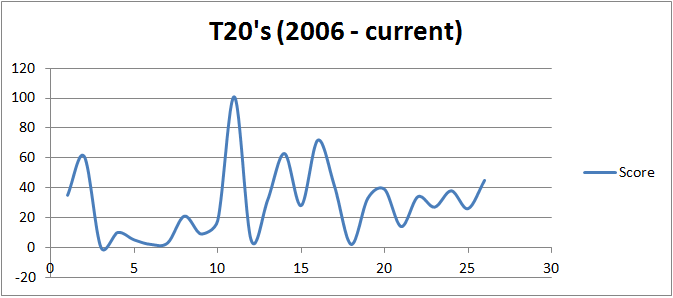
T20’s: Raina has played a total of 32 International T20 matches (28 innings) at an average of 33 and strike rate of 136. Out of the 32 games, he played just 4 in India. The following graph shows a snapshot of the runs scored in all the innings he has played so far. X-axis shows the number of innings played and Y-axis shows the runs scored.

Cricketer Suresh Raina's batting analysis in T20s - Twenty Twenty format
Cricketer Suresh Raina’s batting analysis in T20s – Twenty Twenty format


The graph clearly shows that Raina has got consistent with time. He did not start his career on a very high note (he averaged just over 17 in his first 10 matches). Currently he might not be scoring high, but he is getting scores of 30-40 almost regularly, which for a down the order batsman in T20 is quite good.

ODI’s: Raina has played a total 151 ODI’s (2005 – 2012) at an average of 35 and strike rate of 93. Let’s analyze his performance for the games played from 2009 onward. Analyzing the games played in India (home conditions) and abroad separately. He has played 31 matches in India in the last 3 yrs and scored 762 runs at an average of 40.

Cricketer Suresh Raina's batting analysis in ODI's played in India
Cricketer Suresh Raina’s batting analysis in ODI’s played in India

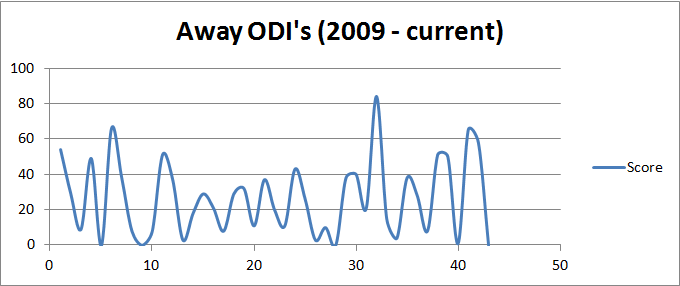
The graph shows that though he is not very consistent, but he is fairly consistent. He scores around 3-4 decent scores of 40+ and then gets a low score. If we compare this trend to his performances on foreign soil in the last 4 yrs, there is a stark difference. The following graph captures his batting performances abroad in the last 4 yrs.

Cricketer Suresh Raina's batting analysis in ODI's played overseas
Cricketer Suresh Raina’s batting analysis in ODI’s played overseas


His batting average for the last 46 matches played abroad is 32. The graph has similar troughs. He does well in a couple of games and then gets out cheaply. Thus, he is not a very consistent player on foreign soil.

Tests: He made his test debut in 2010 against Sri Lanka at Colomo. In the 17 matches (29 innings) he has played so far, his average is a measly 28.

Cricketer Suresh Raina's batting analysis in Test matches
Cricketer Suresh Raina’s batting analysis in Test matches

The graph shows that his test career has been very inconsistent. He has hit even a deeper slump recently, his last 5 scores being (0, 0, 3, 55, and 0). Thus, after a good start to his career he has not been able to maintain his ground in test cricket. He needs to establish himself in this format else there are promising youngsters waiting in the wings!?

A video clip on Raina:


PS: Raw data used for analysis taken from Statsguru – Cricinfo.com


Notice: ob_end_flush(): failed to send buffer of zlib output compression (1) in /home/cricbolco/public_html/blog/wp-includes/functions.php on line 4350

Notice: ob_end_flush(): failed to send buffer of zlib output compression (1) in /home/cricbolco/public_html/blog/wp-includes/functions.php on line 4350